
CRA-readiness evidence, reports and controlled follow-up for connected-product teams
PAXECTReadiness
Home / CRA Knowledge Hub / Readiness Report follow-up
Cyber Resilience Act / CRA-readiness reports

Why a Readiness Report is only the start

What happens after a CRA Readiness Report?

A Readiness Report can show useful information about a connected product, but it does not make the next decision by itself.

The report helps the customer see what was reviewed, what was found, which evidence is missing and which follow-up questions may need attention. Its value starts when the customer reviews the report, decides who owns the next step and chooses what should happen next.

For some teams, that next step may be an internal review. For others, it may be a supplier question, a remediation guidance route or a customer-approved follow-up action. The important point is that the report should not sit unused after it is created.

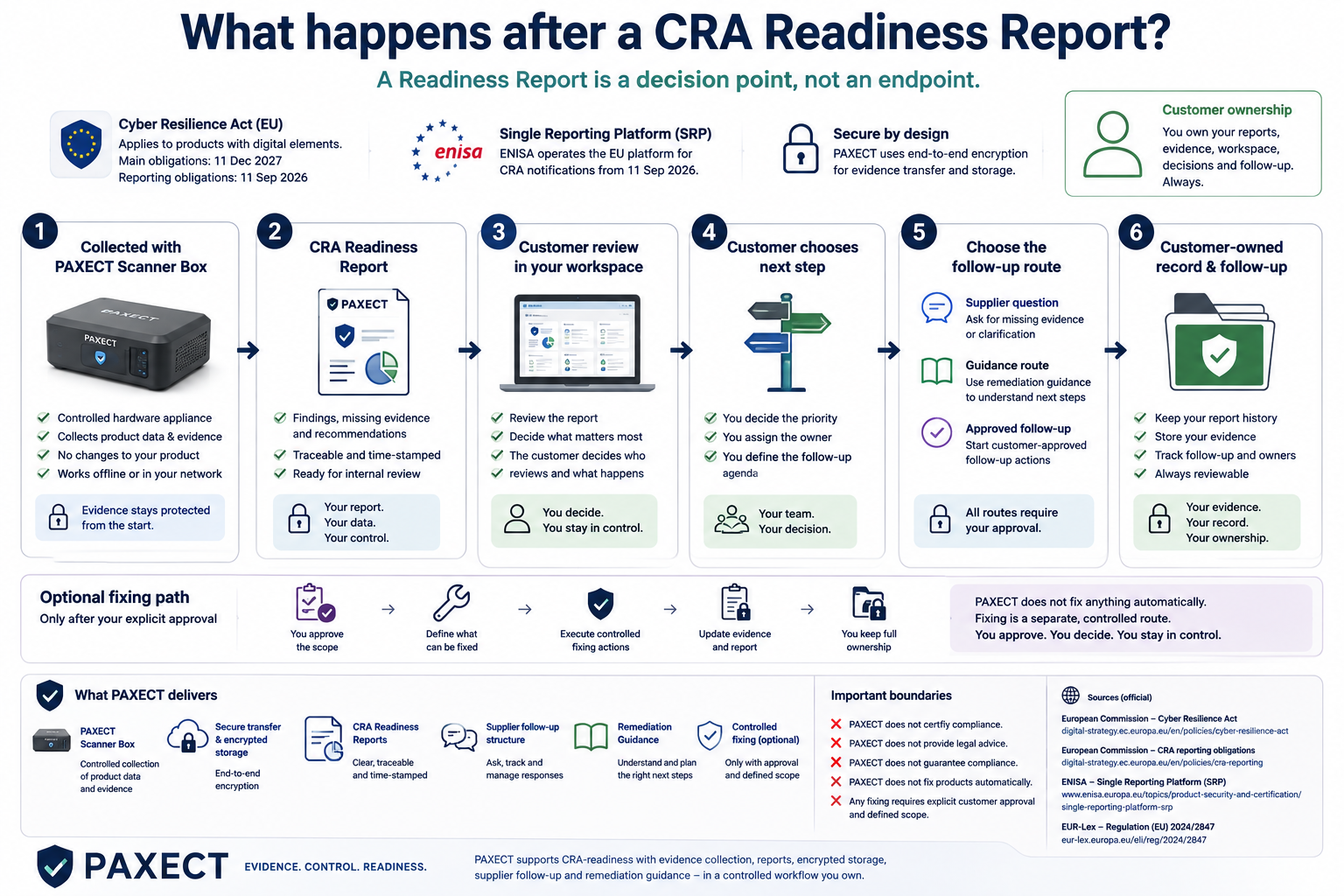
Visual overview of what happens after a CRA Readiness Report: Scanner Box, Readiness Report, customer review, follow-up route, evidence record, optional fixing, boundaries and sources.
Visual overview: a Readiness Report is a decision point, not an endpoint.
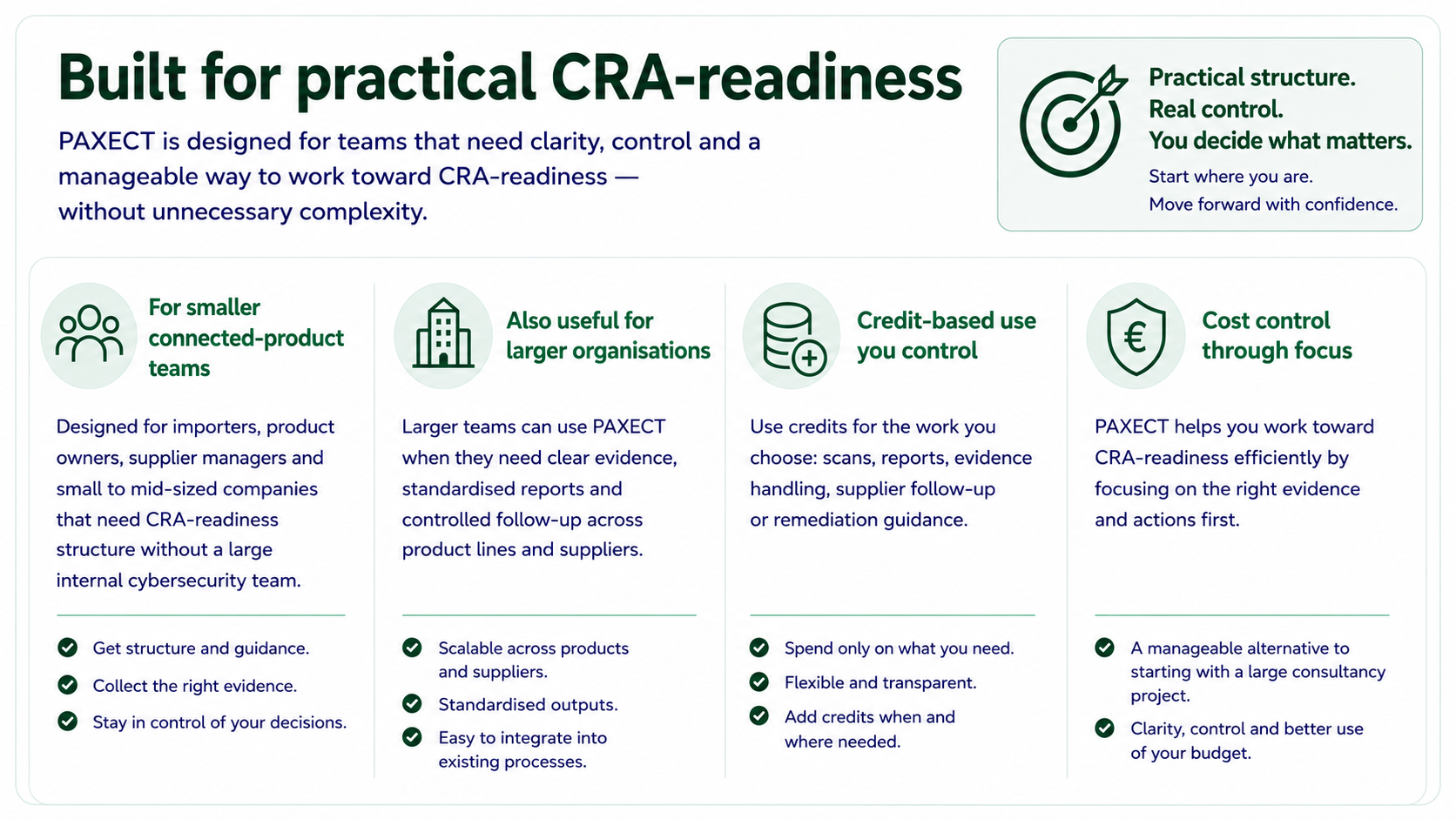
PAXECT is built for practical CRA-readiness for smaller connected-product teams, with credit-based use and focused cost control.
PAXECT is especially practical for smaller connected-product teams that need structure, credits and cost control.

Why the report matters

A Readiness Report matters because it gives the customer a clearer view of the product evidence situation.

It can help show which checks were performed, which findings were recorded, which evidence is available and where information is still missing. That does not mean the report gives a final legal answer. It gives the customer a structured starting point for review and follow-up.

This is especially useful when evidence is spread across firmware files, supplier documents, technical findings, update information, support expectations or earlier communication. The report helps bring that context into one place so the customer can decide what needs attention next.

What the report does not do

A Readiness Report is not a certificate, legal conclusion or compliance guarantee.

It does not approve a product for the market, replace legal review or remove the responsibility of the manufacturer, importer, distributor or customer. It also does not mean that PAXECT reviews private customer reports or takes ownership of the customer’s evidence.

The customer owns the reports, stored evidence, workspace review and final decisions. PAXECT provides the readiness workflow, report structure, evidence handling and follow-up routes, but the customer decides how the report is reviewed and what should happen next.

The report also does not automatically fix products, firmware or software. Any follow-up or remediation route requires explicit customer approval, defined scope and customer control.

The decision moment after the report

After a Readiness Report is created, the next question is not whether the product is finished. The next question is what the customer wants to do with the information.

The customer can decide who should review the report inside their own organisation or workspace. That may be a product owner, security contact, supplier manager, compliance owner or another responsible person.

This decision point matters because findings and missing evidence can lose value when they are not assigned to anyone. A report becomes more useful when the customer chooses a next-step owner and decides whether the situation needs internal review, supplier follow-up, remediation guidance or a customer-approved follow-up route.

Choose the follow-up route

The next step after a Readiness Report does not have to be the same for every product.

If the report shows missing supplier information, the customer may create a supplier question or Supplier Request. If the report shows a technical finding that needs more context, the customer may use remediation guidance to understand possible next steps. If the customer wants PAXECT to support a follow-up or fixing route, that route must be approved separately with a defined scope.

This keeps the process controlled without taking ownership away from the customer. The report supports the decision, but the customer chooses the route.

Keep the record reviewable

After the customer reviews the report and chooses a follow-up route, the decision should remain easy to find later.

That does not mean PAXECT takes over the customer’s evidence or decision-making. It means the customer can keep report references, evidence gaps, supplier questions, guidance routes and follow-up status connected inside the readiness workflow.

A reviewable record helps the customer understand what was checked, what remained open, who owned the next step and which route was chosen. This is useful for internal review, supplier follow-up and later readiness planning, without turning the record into a certificate or legal conclusion.

Simple follow-up flow

A simple post-report flow can look like this:

  • Readiness Report
  • Customer review in the customer workspace
  • Customer chooses the next-step owner
  • Supplier question, guidance route or customer-approved follow-up
  • Customer-owned report and evidence record

This keeps the value of the report connected to the customer’s own review process. PAXECT provides the readiness workflow, report structure and follow-up routes, while the customer keeps control over the report, evidence, workspace and final decisions.

Source context

The Cyber Resilience Act applies to products with digital elements made available on the EU market. The European Commission states that the main CRA obligations apply from 11 December 2027, with reporting obligations applying from 11 September 2026.

ENISA explains that the Single Reporting Platform is the CRA reporting route for actively exploited vulnerabilities and severe incidents impacting the security of products with digital elements.

Sources: European Commission — Cyber Resilience Act, European Commission — CRA reporting obligations and ENISA — Single Reporting Platform

FAQ

Is a Readiness Report the final answer?

No. A Readiness Report is a structured review point. It helps the customer see findings, missing evidence and possible follow-up areas, but it does not certify the product or replace legal review.

Who decides what happens after the report?

The customer decides. PAXECT provides the workflow, report structure and follow-up routes, but the customer owns the report, evidence, workspace review and final decision.

What if supplier evidence is missing?

The customer can use the report as a starting point for a supplier question or Supplier Request. The supplier response still needs to be reviewed by the responsible organisation.

Can PAXECT help with fixing?

Yes, but only as a separate customer-approved follow-up route. PAXECT does not automatically fix products, firmware or software. Any fixing or remediation support requires explicit approval, defined scope and customer control.

Does the report prove CRA compliance?

No. The report supports CRA-readiness preparation. It is not a CRA certificate, legal opinion, compliance guarantee or market approval.

Turn a Readiness Report into a controlled next step.

PAXECT helps customers collect product evidence with the PAXECT Readiness Scanner Box, structure Readiness Reports, keep report context reviewable and choose a controlled follow-up route. That route can include supplier questions, remediation guidance or optional customer-approved fixing support.

PAXECT supports CRA-readiness preparation with evidence collection, reviewable reports, supplier follow-up and remediation guidance. PAXECT does not certify CRA compliance, does not provide legal advice, does not guarantee compliance and does not automatically fix products. Any follow-up or remediation route requires explicit customer approval and defined scope.